It’s hard being the son of a politician.
This folks, is honor. It gives me hope about the future of North Carolina.

It’s hard being the son of a politician.
This folks, is honor. It gives me hope about the future of North Carolina.
Note: This post is a personal theory based on circumstantial evidence. I hope it starts a conversation that needs to be had. Now on with the show…
Fayetteville is borrowing money to to build our new baseball stadium. We’re using a “TIF” to pay back the money. If you’re wondering what that is, here’s an explanation:
What is a Project Development Financing/TIF?
A project development financing (hereinafter referred to as TIF) is a type of debt financing in which a local government establishes a district and borrows monies to fund public infrastructure projects that will benefit (and incentivize) new private development in the district. The unit pledges as security for the loan (and uses as funds to repay the loan) the incremental increase in property tax revenue generated within the district due to the increase in property valuation caused by the new development.
Fayetteville has gone all-in with this TIF thing. The idea is that economic growth surrounding the stadium will pay for the stadium in the long run, without increasing taxes on Fayetteville residents. Here’s City Manager Doug Hewett explaining how the parking garage, hotel and office tower under construction next to the stadium will “provide revenue to fuel the synthentic TIF.”
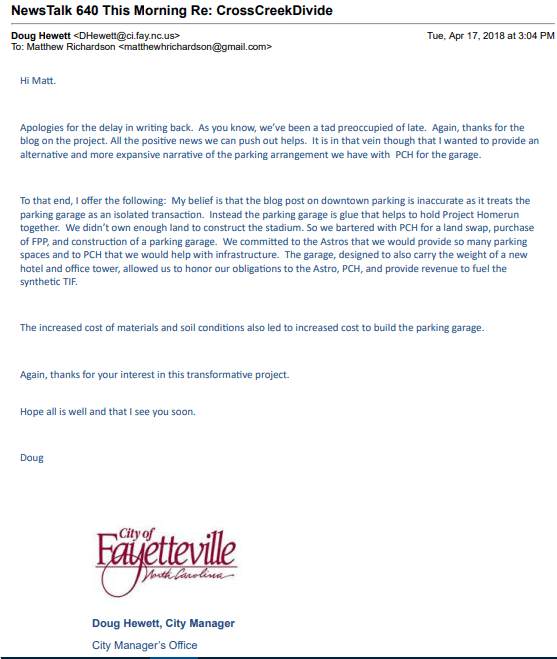
As you can see, Fayetteville needs private development and the increased tax base that comes with it to finance the stadium.
The stadium is at least $7 million over budget.
It was projected to cost $33 million. Unsurprising to anyone who’s ever paid a contractor to build anything, the cost has grown to over $40 million. City officials are doing their best to encourage you to look the other way:
(Assistant City Manager Kristoff) Bauer said he does not anticipate that the extra costs will require a property tax increase. Bauer said revenues to pay off the bonds are coming from sources such as ticket sales, renting out the stadium, and tax district in downtown where any revenue from rising property values will go toward the stadium debt.
“We’re seeing it happen faster and at a higher value that we expected,” he said.
The city took out limited-obligation bonds to fund the stadium’s construction. Cumberland County is pitching in as well, contributing revenue from downtown property taxes.
There are two possibilities:
Or, 2. The City needs to find more money.
My money’s on 2.
The additional $7+ million needed to construct the stadium will have to come from a source not contemplated in the city’s original projections.
Lately, there have been rumblings in local press and radio of City Hall being sold along with the police station next to it. The justification is that these buildings are now sitting on “prime real estate” thanks to downtown development.
Let me point out that I think that’s an absurd reason to sell a public building. City Halls are supposed to sit on prime real estate, and they do in most of the cities I’ve been to.

Moreover, Fayetteville’s City Hall and police station are relatively new and modern. Why waste these buildings and incur the cost of new land and construction???
It’s very simple: City leaders have put a great deal of political capital into the stadium and the downtown development project. They can’t afford to let it fail.
And so, City Hall and the police station will be sold to a private developer. The real estate will be added to the downtown development district where it will “provide revenue to fuel the synthetic TIF,” as Mr. Hewett would say.
And so, we’re selling City Hall to play ball.
One of my legal heroes is Justice John Paul Stevens who retired from the Supreme Court in 2010. I got to see him live on the bench when I was in college, and he reminded me of my late grandfather. He rocked a bow-tie throughout the decades.
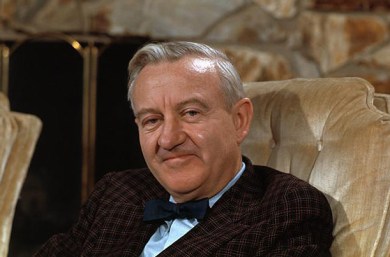
Stevens was appointed by Gerald Ford, a Republican, and came to be known as a “liberal” justice in his 35 years on the bench. One might say he evolved with the times while his party didn’t. I am the “one” who might say that.
I thought of Stevens after reading a short editorial in the Fayetteville Observer and some recent news about Governor Cooper. We’ll start with the Observer’s piece titled, “The Price of Politics“:
After every election on just about every level of government, we shake our heads a month or two later as we learn how much candidates have spent to win their races. We’re doing that this week as we try to absorb the news that Wesley Meredith and Kirk deViere spent a total of nearly $2.4 million on the campaign for the N.C. Senate seat that Meredith lost and deViere won.
That’s astonishing, really — $2.4 million for a job whose base pay is a bit under $14,000 a year. Even with per-diem expense payments and other extras, that seat sold for many multiples more than it will return to winner. And the grand total is even more than $2.4 million, because the campaign finance reports don’t track what advocacy groups spent to promote the candidates. The money came from individual donors, the political parties and from political committees. Ultimately, a big chunk of it came from people with deep pockets, people who spend lavishly on political campaigns.
And do you suppose they expect something in return? Based on what we see happening in the General Assembly in any given year, it appears the donors get what they’re looking for.
And what about we, the people?
Yes, we still need campaign finance reform. More than ever.
Now for the news about Governor Cooper:
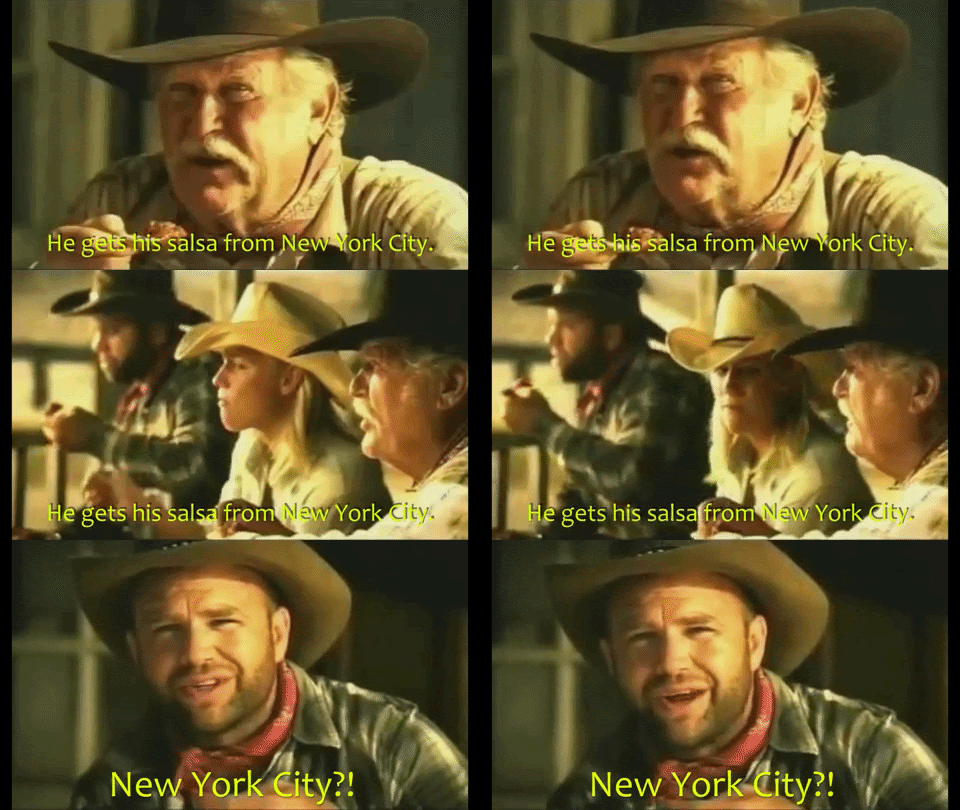
It seems he’s kicking off his re-election campaign in New York City!?
Why in the world is “Nash County” Cooper announcing his re-election bid in New York? Well, besides failing politically, he’s raising a lot of money from people with a lot of money. Cooper’s not a political novice. He had to know there’d be blow-back, and he’s decided that it’s worth the cash.
Predictably, the Republican Party was all over it:
“By announcing his re-election campaign for governor of North Carolina in New York City, that tells voters all they need to know about Roy Cooper,” NCGOP chairman Robin Hayes said. “Behind that folksy facade is a big-city liberal Democrat ready to bring failed tax-and-spend policies to NC to please his wealthy Wall Street donors.”
Even though it’s low-hanging fruit for Chairman Hayes, it’s a bit hypocritical. Remember last August:
Robin Hayes, chairman of the NC GOP, spoke at the fundraiser for U.S. Rep. David Rouzer at the Figure 8 Yacht Club in Wilmington on Aug. 10 when he asked attendees to donate to the party organization to help Rouzer…
“This is an envelope. You have heard things that should inspire you to dig deep tonight. But federal law says you can only give, you and your wife, $5,200 to David Rouzer,” Hayes says in the recording. Rouzer then corrects him to say the individual federal spending limit is $5,400 per year.
“But you can take this envelope, put money in here and give it to your friend and citizen, Robin Hayes, who happens to be party chair and I can take unlimited money and put it to his campaign, legally,” Hayes said.
How many yachts in the Figure 8 Marina on August 8th, 2018 had the words “North Carolina” written on the stern? I bet less than half.
Back to Justice Stevens, who wrote the dissenting opinion in Citizens United, the seminal campaign finance case. Stevens argued that the government should be allowed to place reasonable restrictions on the way corporations advertise in political elections:
At bottom, the Court’s opinion is thus a rejection of the common sense of the American people, who have recognized a need to prevent corporations from undermining self government since the founding, and who have fought against the distinctive corrupting potential of corporate electioneering since the days of Theodore Roosevelt. It is a strange time to repudiate that common sense. While American democracy is imperfect, few outside the majority of this Court would have thought its flaws included a dearth of corporate money in politics.
Stevens lost this one. You can thank the five winning Justices on the court for a great deal of the political mailers and ads you see on TV around election time.
Barack Obama criticized the majority opinion in Citizens United in a State of the Union Address, arguing that it opened the floodgates to foreign money in American politics. This drew a “Not True” from an aggravated Justice Alito:
Flash forward to 2019, and the FBI is hopefully wrapping up a multi-year investigation into Russian interference in our elections. Raleigh and Charlotte were targeted by the Russians in 2018. Perhaps Obama was onto something?
In the end we’re left with real world examples of a broken system. It makes everyone a hypocrite, and our leaders become beholden to everyone except the people that actually elect them. So what’s the answer? How do we fix it???
Justice Stevens had a solution to all this, after he retired:
He proposed the adoption of a constitutional amendment providing that: “Neither the First Amendment nor any provision of this Constitution shall be construed to prohibit the Congress or any state from imposing reasonable limits on the amount of money that candidates for public office, or their supporters, may spend on election campaigns.”
In support, Stevens argued:
“While money is used to finance speech, money is not speech.”
His proposal was rejected by many Republicans, including Senator Rafael Edward Cruz (R-Texas), who said:
“Money is and always has been used as a critical tool of speech.”
And so it will remain.
Yesterday, the Fayetteville Observer reported on the parking study that was published on Cross Creek Divide a few days ago. The experts conducting the study encourage our city leaders to charge more for parking downtown. Read the Observer article here for a primer: Study Points to Paid Parking for Downtown Fayetteville.
The Observer interviewed the familiar talking heads for downtown, and it seems that all the experts think charging more for parking is a good idea. 95% of the comments to the article from regular citizens suggest otherwise.
What struck me was Jordan Jones’s take on the issue:
Jordan Jones, the project manager for converting the former Prince Charles Hotel into high-end condos with ground-floor restaurants, said this is the right time for the city to move ahead with a detailed parking plan.
“With all of the demand we’re adding, with all the new businesses we’re bringing down there, it is time to really shift over to paid on-street parking,” he said.
First off, why does Jones care? His parking needs are taken care of. The City is purchasing a brand new parking deck and then leasing it back to Prince Charles Holdings for insanely discounted rates:
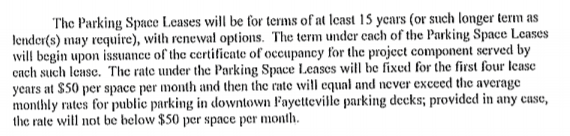
So Jordan Jones and Prince Charles Holdings will get City-owned parking for $50/month or $1.66/day. Everyone else will be lucky to get $1.66/hour.
Is this fair to every other business downtown? Their customers will be filling up a running meter to buy a cup of coffee, shop for art, eat a fried turkey sandwich, or stop by for a meeting with their attorney. Many of these businesses invested in downtown long before “Project Homerun.”
There’s nothing immoral about making money, and we should encourage investment downtown, but when public resources are being used by private businesses to make said money or encourage said investment, I think we should be as fair and transparent as possible. That hasn’t happened in this case. If you think it has, ask a random person on the street whether the parking deck will be used for baseball games. You might be surprised by their response.
I’ll close this one with former mayor Tony Chavonne, who is in favor of more paid parking:
Chavonne said he expects some businesses to be opposed to paid park.
“Undoubtedly, with any kind of change, there will be people not necessarily supportive of this,” he said. “The city just can’t continue to give away its most valuable asset, and that is convenient parking. That just doesn’t even make any sense if you think about it.”
The City is already giving away its most valuable asset, to Prince Charles Holdings.
What doesn’t make sense, if you think about it, is that everyone else is going to pay for it.
If so, you’re old-fashioned. It’s time to get with the “new paradigm” and pay up according to the group of experts that were hired with your tax dollars to perform a parking evaluation of downtown Fayetteville:
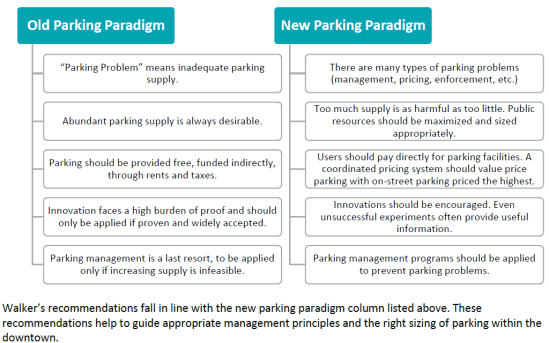
According to these experts, “too much supply is harmful.” Really??
My favorite: “Public resources should be maximized and sized appropriately.” This is a fancy way of saying your local government should make money off of you. Get ready to pay a lot more to park downtown.
If you want more information, a draft of the study can be viewed here: parking study report draft 12 28 18 with appendix r revised final draft (002)
At first glance, the study seems to imply that the “new Stadium Garage” can be used for baseball games, which we know is not the case.
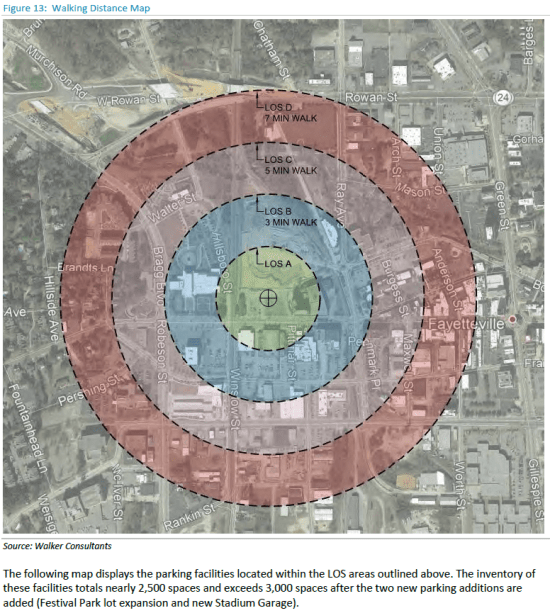
It will be interesting to see how the City Council reacts and whether any of the findings are questioned. I’ll update this post accordingly.
To close, wouldn’t it be nice if there was a parking deck that was open to the public in the middle of the bulls-eye???
 Cross Creek Divide