In a surprising move, The Fayetteville City Council voted 5-4 against borrowing additional money to fund the Prince Charles Holdings (PCH) parking deck downtown.
In short, my prediction in the post below was incorrect.
But this is one time that I’m happy to be mistaken. The mayor and the four other “no” votes should be commended for finally standing up for the taxpayers of Fayetteville. It was a small win for responsible government and fiscal sanity. It also demonstrates the power of shining sunlight on these deals. The local press and the community finally began looking at the fine print. Our elected leaders followed suit. That’s how the process is supposed to work.
So where do we go from here?
Just over a month ago, PCH representatives told the council that they were not certain they could finish the planned Hyatt hotel and offices on top of the deck without the additional money from the city. Well, the council has called their bluff. The current contract price of 14.7 million is still in place and still enforceable.
Time will tell whether the council members will hold this position and whether PCH will honor its contractual obligations.
I have a feeling that this isn’t the end of the story.
ORIGINAL POST
Tonight, the Fayetteville City Council will vote to borrow millions more to build a parking deck to service a private corporation while it continues to raise parking rates on the general public downtown.
However, the council will not be up front about it, at least not at first. Instead, we will hear the same lip-service we heard the last time this issue came up, things like:
“We’re not making the decision to spend the money today.”
“We’re just giving ourselves the option in the future by making sure the money’s available.”
“We can always give the money back if we decide not to spend it.”
In other words, you’re going to be lied to. They’ve already calculated the interest on the money they’re going to borrow, to the dollar. It’s a done deal.
In case you’re wondering, it’s going to cost Fayetteville citizens another $2,136,682 to placate Prince Charles Holdings (PCH). Otherwise, they may just pack up their crane and go home, and we can kiss our Hyatt Hotel goodbye. Maybe then we could use the parking deck??
Along those lines, you’ll probably hear from other concerned downtown business owners at tonight’s meeting as well. Apparently, people don’t want to go eat at a restaurant or buy a cup of coffee if they have to pay 10 bucks to park nearby. Who could’ve seen that coming? By the way, there’s seven home baseball games in a row this week. That’s a lot of missed revenue.
Since we’re playing with dollars now, remember that the reason given by the council for charging the public increased parking fees was that Fayetteville was losing approximately $250,000/year in downtown parking. “Free parking isn’t free,” they said.
My son is into division right now and he’s pretty good at it. He might be able to tell you that $250,000 will go into 2 million about eight times.
So…. we could:
Not give PCH this extra money;
Keep downtown parking “as is” (mostly free); and
Remain in the same financial position until 2027.
But we won’t do that. It makes too much sense.
In the end, the council members have already made up their minds, and they are going to give PCH everything it wants. The success (or at least the appearance of success) of this project is too important to them, politically. It’s the tallest albatross in town.
This site has been live for over a year now. I have posted over 80 different articles covering a range of topics, many controversial in nature. To this point, I have only taken down one. It was a post entitled “Leave it in the Dirt” in which I criticized the new Civil War Center being built in Fayetteville. I took it down because it angered and upset certain people who support the museum. For context, here’s how the post ended:
Instead of reading the tea leaves that say, very clearly, that young people are fed up with North Carolina’s celebration of the confederacy, Fayetteville has chosen a new path in the exact same direction. Yes, we’re going to take this emotionally charged, painful history and put a shiny new cover on it and tell “both sides of the story” in our “museum of the future.”
The problem with the “museum of the future” is that it celebrates the past when it’s way past time to move forward. It’s way past time to move on.
Leave it in the dirt where it belongs.
I take some pride in standing by my opinions, but I didn’t in this case. The conflict didn’t seem worth it, and I retreated with a click of my mouse. But I knew the battle would go on, and so I was not surprised when the museum found its way back into the news this week.
Colvin Steps into the Breach
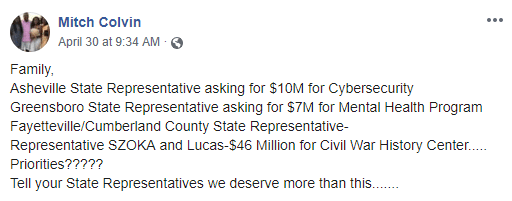
On April 30, the mayor of Fayetteville stirred up a skirmish over the new museum, questioning the project’s funding on his Facebook page:
Colvin’s argument is that the state’s money could be better spent on more pressing issues. He was interviewed about his comments by local news sources, and here’s some of the media coverage that ensued:
Representative John Szoka, the sponsor of the legislation funding the center, said he was “perplexed” by Colvin’s position because the Fayetteville City Council had unanimously supported the project in the past. Szoka’s correct. Here’s Colvin with a golden shovel in his hand (along with Rep. Szoka and others) at the groundbreaking ceremony a year ago:
Szoka was quick to defend the project’s economic impact. He believes the museum will be a tourist destination, drawing visitors from across the state.
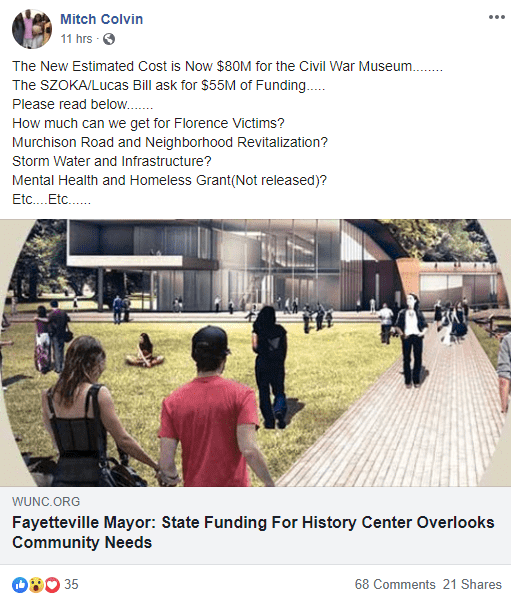
Colvin didn’t back down from his new position. Apparently liking the sting of this battle, he doubled down last night with another Facebook post:First, let me point out how profound this is politically. There is a bill in a state legislature to give a municipality over 55 million for a construction project in the municipality. This is free money. Just, here you go, have 55 million dollars.
The mayor of that municipality is now publicly chiding the expenditure, saying the money should be spent on other things like Florence relief and infrastructure. He’s basically telling state legislators how to do their job, a “thanks, but no thanks,” if you will.
“Increase Our Divide”
At the groundbreaking ceremony that Colvin attended, Former Governor Jim Martin told the crowd that he prayed the museum “would be an instrument of healing through our part of a divided country.” Colvin himself stated “this was something that will bring us together, not increase our divide.”
So why is Colvin now challenging the project after publicly supporting it?
There are two ways to look at Colvin’s actions, one is the raw political take, the other is the human side:
It’s easy to see Colvin’s actions as political hedge. This project has been controversial in the African American community from the start. It’s going to be built on the top of Haymont Hill, the site of the old Confederate Arsenel. By criticizing the project without really challenging it, Colvin is giving lip service to those critics. He’s also giving red meat to Hurricane Florence victims who are fed up with government in general right now. You could also argue that Colvin is trying to change the narrative, shift blame, or rally people to his side. It could be any of these things.
But I think it’s deeper than all that.
I think Colvin, like me, is personally conflicted about the entire project. He admitted at the groundbreaking ceremony that it was “difficult” for him to embrace the museum initially, but he came around when he learned that it would tell the full story of the war and its aftermath, including its impact on African Americans. Now he’s trying to “unembrace” it. Unfortunately, politicians (unlike bloggers) don’t get to “unembrace” ideas with the click of a mouse.
And so I’m left with the same take I had when I wrote about this project a year ago. This museum, although it has admirable goals, will not bring people together. The Civil War, by its nature, cannot do that. It is and always will be about race. We cannot “tell both sides” without making a moral judgment about one of them, and there is only one right side of this history. Fayetteville wasn’t on it in 1860.
Charlottesville, Chapel Hill, and recent presidential politics have demonstrated that our nation is still grappling with this debate, and our state and local leaders have made a policy decision to bring the debate, front and center, to Fayetteville.
Maybe Colvin’s right that our resources could be better spent on other things. I guess he should have left that golden shovel in the dirt where it belongs? Instead, he’s using it to dig a trench between our community and our state delegation.
The Cross Creek Divide just got a little bit wider. But don’t worry, there’s still “very fine people on both sides.”
After some fairly decent reporting about the downtown development drama in Fayetteville, our paper’s editorial board has taken the position that the the City of Fayetteville and Prince Charles Holdings are officially a thing. This relationship is here to stay, and naysayers can get out of the way:
City risks aside, the idea in some quarters that the Prince Charles people are getting over is not true. This is a true partnership, to include the Woodpeckers, where the partners are hand-in-hand and will rise or fall together.
“City risks aside…,” I love that. All relationships have risks, right? And you can’t really love unless you’re willing to risk everything.
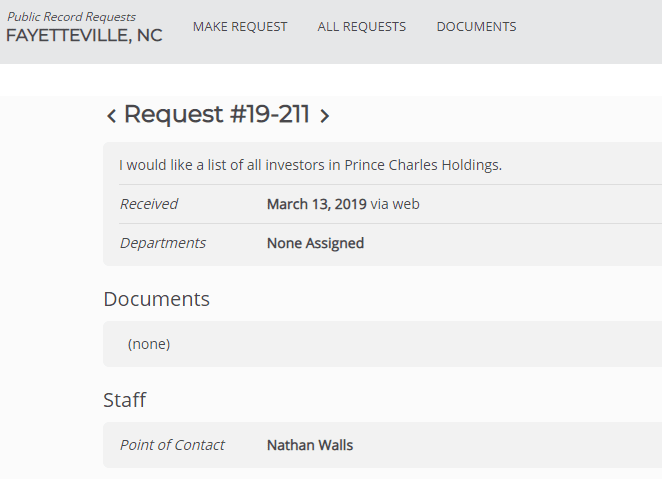
Sarcasm aside…a few weeks before the Observer’s opinion piece ran, someone made a relevant public records request. (I would take credit if it was me. It wasn’t). The request was one sentence long, and it was answered by City officials the next day:
So let’s discover whom we’re going to walk hand-in-hand with into the future of downtown Fayetteville:
Apparently, we don’t get to.
What it Means
Our deal with Prince Charles Holdings (PCH) is what we call an “economic development incentive.” In short, we are giving PCH something in exchange for PCH’s investment in downtown. In this case, we are giving PCH a 16+ million dollar parking deck to use for $1.66 per space, per day. In return, we are getting increased tax revenue and jobs in the form of offices and a hotel.
Here’s the rub: PCH is not a Black and Decker, Walmart, Dell, or B.M.W. In short, it’s not a publicly traded company with a track record of honoring its financial obligations. My pre-school son has existed longer than PCH and has probably honored more promises.
All of this makes it worthwhile to know, or at least know the identity of, the folks we are dealing with. Is it local businessmen and investors we can trust, with a history of fair dealing? Have any of them personally guaranteed PCH’s obligations? The “risk” so swiftly brushed aside by the Observer is born entirely by the taxpayers of Fayetteville. If the synthetic-tiff (google it) financing fails, the City will have two choices: increase taxes or cut city services to pay for the new construction.
I’m willing to bet that most of the members of the Fayetteville City Council have no idea who invested in PCH. If they do, do you think they have an obligation to tell the public before they give PCH another 2 million dollars of our tax money in May? If they won’t tell us, the Fayetteville Observer needs a new headline because while the City Council and PCH may be hand-in-hand partners, the public never got a key to the closed-door meetings that lead to this relationship.
When Jordan Jones “dropped by the Fayetteville Observer offices” a few weeks ago (apparently he gets to do that), he wanted people to know that PCH has “serious skin in the game” and that the public is “unaware just how deep (PCH) is launching out into the sea.”
I’d feel a little bit better if I knew who was really steering the ship.
On April 10, 2018, this website became the first media outlet to publish the development contract between the City of Fayetteville and Prince Charles Holdings (PCH). The post (No Parking: Fayetteville’s 14 Million Dollar Mistake) caused a small stir in the community and efforts were quickly dispatched to discredit it. City Manager, Doug Hewett, called the post “inaccurate” on public radio. Former Mayor, Tony Chavonne swept in with a “parking study” to show that everything was fine. The parking deck, they said, was the “glue” that held a much bigger project “together,” one that would benefit Fayetteville in the long run.
Follow up posts on this site challenged the “public purpose” and constitutionality of the garage contract. In another, I pointed out the hypocrisy of Fayetteville building a parking deck to service private development while refusing to repair washed-out dams on private land. But city leaders kept plowing forward, blinders on, full-steam ahead.
At a certain point, you start to feel like a voice in the wilderness. Like-minded members of the community and I have been called “conspiracy theorists.” Some people ask why we don’t sit back and let the project happen. We would be “right” or “wrong” depending on how it shakes.
I have one response: I care about this community, and I believe our elected leaders should be stewards of our resources and act in the best interest of the public, not wealthy investors. They can only do so by reading the fine print of contracts they enter into on our behalf. Last night’s city council meeting was the first time I felt that my elected leaders shared that sentiment with regard to this project.
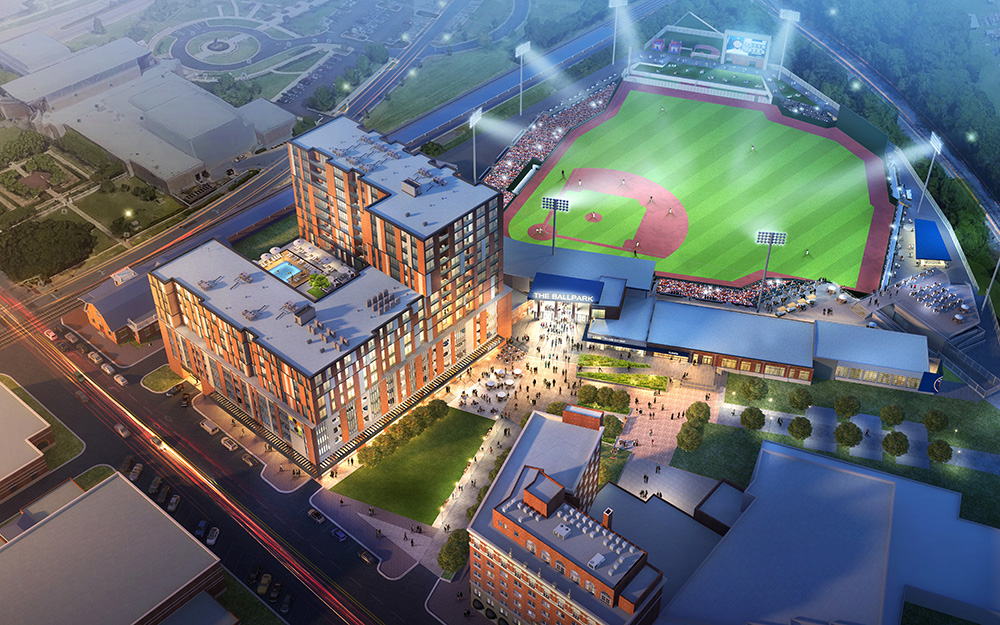
“Project Homerun” was sold as a package deal. Every glossy photo and video put out by the city had pictures of the parking deck and the stadium together. The city website calls it an “economic homerun” for Fayetteville.
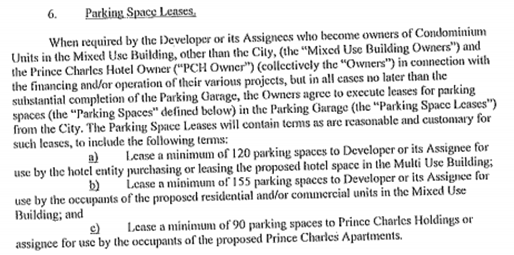
As a result of these marketing efforts over the past few years, most citizens believed (and many still do) that the deck would be used to service the stadium next to it. It won’t. Here’s the fine print from the City’s contract with PCH:
Prince Charles gets 365 spaces in the City’s new deck and pays $50/month, or $1.66/day
This past week, the Fayetteville Observer once again printed the fact that the parking deck will not be used for games. Opening day is drawing closer, and people are starting to pay attention. The details of the deal are starting to affect them personally.
Read any of the comments to the articles surrounding the parking deck on the Fayetteville Observer’s website or Facebook page. They aren’t positive. Several facts that I have been screaming from the rooftops for over a year are finally sinking in the public consciousness, and the public isn’t happy. Our leaders are starting to listen.
More Money, More Problems
Last night, PCH proposed a few “amendments” to the contract. In short, they wanted:
50 more spaces at $1.66 a day, for a total of 415 out of the deck’s 507 spaces; and
1.5 million more from the city (2.1 million w/interest costs).
PCH can’t get the additional funds from private sources. According to PCH, and in spite of the 40 million dollar stadium we’re building next to their development, downtown Fayetteville’s not an attractive business opportunity to private investors:
“The challenge we have here, today, is the returns we’re going to get (for our investors), from leasing office space and selling room nights in a hotel, are significantly below the rates you’re able to get in a Raleigh, and a Durham and a Charlotte.”
“We’ve talked to opportunity funds about investing….Fayetteville simply is not on their radar”
“The returns these two buildings are going to generate for our equity investors are still lower than they would in Charlotte or Durham.”
Jordan Jones (PCH) 4/1/19
Doesn’t that make you feel good about your hometown? Our “business partners” are now blaming us for their inability to honor a contract price. They need us to pitch in more, and their “leverage” is a veiled threat that they won’t be able to finish the project if they don’t get the extra cash:
Jones said without the city’s help in paying for cost overruns for the garage his company was not “100 percent” certain it can secure the financing to finish the office and Hyatt Place hotel projects.
Fay. Observer 4/2/19
In short, if you want a hotel and office building on your tax books, you’ve got to pony up more dough.
Councilman Larry Wright was not fond of being “leveraged”:
“It’s almost like you’ve got us over the barrel and it’s something we’ve got to do.”
Larry Wright 4/1/19
Mayor Colvin continued to grill PCH on the financing, and others asked tough questions. Councilwoman Jensen said that this was a “new contract” as far as she was concerned and she wanted concessions before she would agree to pay more public money. Some finally compared the rate the public is being charged to PCH’s discount parking. I think I even heard one member say how mad he was that the public couldn’t use the deck for baseball games. In sum, we finally started to see Fayetteville’s representatives stand up for Fayetteville.
But then Doug Hewett started “explaining” the deal, and the decision was put off to a later date. We would go back to the negotiating table. You could see the council members start to cave.
The sad truth is they will cave completely because they made a policy decision several years ago to turn the taxpayers of the City of Fayetteville into a bank, and all a bank cares about is getting return on its investment, or, in this case, cutting its losses.
(a) In this section, “downtown development project” means a capital project in the city’s central business district, as that district is defined by the city council, comprising one or more buildings and including both public and private facilities. By way of illustration but not limitation, such a project might include a single building comprising a publicly owned parking structure and publicly owned convention center and a privately owned hotel or office building.
Like this one!
(b) If the city council finds that it is likely to have a significant effect on the revitalization of the central business district, the city may acquire, construct, own, and operate or participate in the acquisition, construction, ownership, and operation of a downtown development project or of specific facilities within such a project. The city may enter into binding contracts with one or more private developers with respect to acquiring, constructing, owning, or operating such a project.
Like this one!
Such a contract may, among other provisions, specify the following:
(1) The property interests of both the city and the developer or developers in the project, provided that the property interests of the city shall be limited to facilities for a public purpose;
(2) The responsibilities of the city and the developer or developers for construction of the project;
(3) The responsibilities of the city and the developer or developers with respect to financing the project.
Such a contract may be entered into before the acquisition of any real property necessary to the project.
(c) A downtown development project may be constructed on property acquired by the developer or developers, on property directly acquired by the city, or on property acquired by the city while exercising the powers, duties, and responsibilities of a redevelopment commission pursuant to G.S. 160A-505 or G.S. 160A-456.
(d) In connection with a downtown development project, the city may convey interests in property owned by it, including air rights over public facilities, as follows:
(1) If the property was acquired while the city was exercising the powers, duties, and responsibilities of a redevelopment commission, the city may convey property interests pursuant to the “Urban Redevelopment Law” or any local modification thereof.
(2) If the property was acquired by the city directly, the city may convey property interests pursuant to G.S. 160A-457, and Article 12 of Chapter 160A of the General Statutes does not apply to such dispositions.
(3) In lieu of conveying the fee interest in air rights, the city may convey a leasehold interest for a period not to exceed 99 years, using the procedures of subparagraphs (1) or (2) of this subsection, as applicable.
(e) The contract between the city and the developer or developers may provide that the developer or developers shall be responsible for construction of the entire downtown development project. If so, the contract shall include such provisions as the city council deems sufficient to assure that the public facility or facilities included in the project meet the needs of the city and are constructed at a reasonable price. A project constructed pursuant to this paragraph is not subject to Article 8 of Chapter 143 of the General Statutes, provided that city funds constitute no more than fifty percent (50%) of the total costs of the downtown development project. Federal funds available for loan to private developers in connection with a downtown development project shall not be considered city funds for purposes of this subsection.
(f) Operation. – The city may contract for the operation of any public facility or facilities included in a downtown redevelopment project by a person, partnership, firm or corporation, public or private. Such a contract shall include provisions sufficient to assure that any such facility or facilities are operated for the benefit of the citizens of the city.
(g) Grant funds. – To assist in the financing of its share of a downtown development project, the city may apply for, accept and expend grant funds from the federal or State governments. (1987, c. 619, s. 1.)
Breakdown
So there’s some law. Some law that’s only as good as the paper it’s written on if it’s not followed or enforced. So let’s explore what’s going on in Fayetteville. Put on your thinking cap and apply the law to the facts of our city’s new downtown parking deck.
When it comes to downtown parking for Woodpeckers games, you might be interested to know that you will not be parking in the new garage overlooking the $40-plus million stadium – not unless you are living in “The Gathering at Prince Charles” or working in an office there.”
“Generally there will be no parking in the parking deck for Woodpeckers patrons.”
“The parking deck will be for office patrons….Hyatt hotel customers and apartment-holders at “The Gathering at Prince Charles…“
If your thinking cap stayed on amid the gusts of obvious blowing in your direction, you quickly realized that Fayetteville’s deal with Prince Charles Holdings doesn’t “mesh” very well with the above statute. So how’d this happen? In short, we wanted to build a stadium without raising taxes, and the guys who wrote the book on downtown development came calling with a “win-win” for the City and…….well…themselves.
Proponents of the deal (and the attorneys who drafted the contract between PCH and the City) will maintain that “economic development” is a public purpose. In short, the deck and the deal will boost tax revenue and spur other growth downtown, and so the contract passes the test. See: Maready v. City of Winston-Salem, 342 N.C. 708 (1996).
If that’s the case, then why don’t we simply give private developers bags of cash if they invest in downtown Fayetteville? It’s what we’re doing already, and it’s a lot more honest. We could even bid it out beforehand to find the developer that would accept the lightest bag of cash in exchange for building a hotel downtown. A minority or local developer would, of course, in keeping with City policy, get a little bit heavier bag of cash if he or she wants to bid.
Seem absurd? So does buying a parking deck, then leasing it back to the person you bought it from at a loss when you could’ve really used the parking spaces.
I know I should stop beating this dead horse. You’re probably tired of reading about it. But the law and the North Carolina Constitution haven’t changed in the year or so that I’ve been on it. Nor are they likely to change in three weeks, when the first pitch is thrown in Segra Stadium and we finally find out whether we’ve got ample parking to handle all the the development we’ve “encouraged” by toeing legal lines.
The problem with toeing the line is you can’t go back if you accidentally cross it.
In the end, the deck isn’t finished, and the City hasn’t purchased it…yet.
Maybe it’s time to take a step back and get all of this right?


 Szoka was quick to defend the project’s economic impact. He believes the museum will be a tourist destination, drawing visitors from across the state.
 First, let me point out how profound this is politically. There is a bill in a state legislature to give a municipality over 55 million for a construction project in the municipality. This is free money. Just, here you go, have 55 million dollars.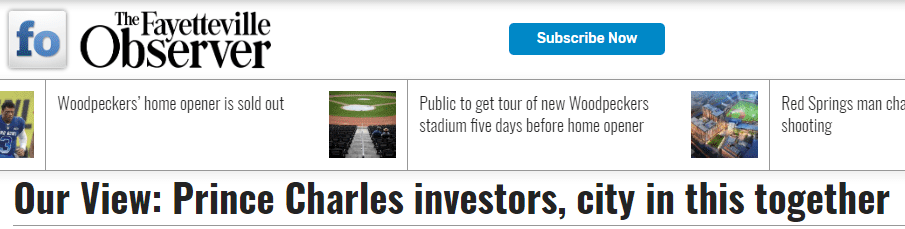







 Cross Creek Divide